Wednesday, 15 June 2011

Bash Helmet in the 1960s. The white heat of technology catches up with our gay comic superhero.

In the spring of 1965, since America’s fascination with new technology was so prevalent, Bona Ventures decided that Bash should have a robot assistant. Issue 32 introduced Beeping Tom.

Primarily built as an observation and recording device, the android had a range of lenses that enabled him to see in a number of different ways. For instance, Tom could see in the dark (‘blackness-vision’) and even through clothing (‘x-rated vision’).

The aptly named Beeping Tom first appeared in Issue 32
The remarkable robot also had a dazzling array of plug-in electrical gadgets that Bash put to full use - sometimes when fighting crime. And when Tom wasn’t required for a mission, he would simply switch to a standby mode and wait for Bash to come and turn him on.

But a few months later, a powerful figure was to silence Beeping Tom once and for all!

By May 1966, Pu Yao-Yun had grown bored of his duties at Bona Ventures and was rarely seen outside of the executive washroom. 

Bud Demsky and Godfrey Pryce held a meeting in which it was decided that they needed to extend their reach into the women’s arena. Neither man felt qualified to do this and so Demsky appointed Regina ‘Reggie’ Furburger as the new editor of Bash Helmet.

'Reggie' in her trademark coveralls
Reggie was Demsky’s former plumber and her remit was simple - increase the female readership.

On her very first day, Reggie called together the artists and writers and held up the latest issue of Bash Helmet which featured Beeping Tom on the cover.

She tore the comic in two before the startled staff and screamed,

“I am sick of electrical appliances - give me a real woman!”

And it was definitely a case of third time’s the charm when Bash was given his next sidekick - Flick Faster!


Bash Helmet Issue 50: Flick Faster takes the comic world by storm


Flick Faster, the high-kicking, high-heeled heroine, took the comic world by storm with her debut in Issue 50. Her origin was simple but effective - Felicity Fisher was a young, hip English undergraduate working part time as a taxi driver in New York City to help make ends meet. 

Feisty female phenomenon, Flick Faster
She had just picked up a pair of American All-Star Women’s Tennis Champions when her cab was struck by lightning. 

The sudden surge of electricity transferred all of the tennis players’ strength, stamina, agility, accuracy and sexual orientations into Felicity who used her new-found powers to give women a hand wherever they wanted it. 

Staff writer, Hernandez Pico is credited with creating her: 


“We were all tasked with coming up with a new sidekick for Bash. I went home and spent a whole afternoon reading through my collection of ‘Tales to Excite’ that he appeared in. I really loved those strong wartime female adversaries - Diva Braun, Fifi Fingersnatch - they had great names and I wanted someone like that to be at Bash’s side. 

Anyway, I had gotten through all of his early adventures with no ideas so I just carried on reading my old Tales for Kidz comics for my own amusement. Then I saw the answer to my prayers in the story “Veg Out!” where Spurt and Squirt go to watch a character called Flick the Bean at the Vegetable Olympics. 

She was a runner bean taking part in the 400 metre sprint and there is a panel where Squirt is shouting out to her, “Go, Flick! Faster!” There was my name! The rest just fell into place.

In order to tie Flick’s history in more closely to Bash’s, Pico wrote a flashback story showing a young Felicity sitting with her Aunt Phyllis with whom she lived in England. Phyllis reveals that, during the war, she had worked tirelessly as a Free FANY and personally helped Bash Helmet to resist any advances from the German soldiers. It was Phyllis who originally encouraged her niece to travel to New York to “try and get a glimpse of that magnificent Helmet.”

With her incredible powers and strong desire to finger female felons, it was not long before Flick Faster became an important part of the Bash Helmet mythos. Reggie was thrilled and her success was confirmed when market research at the time actually indicated that the number of girls reading Bash Helmet was greater than the number of boys. 

In 1967, Flick was given her own spin off title but she still popped up for regular periods in Bash Helmet’s comic.

In Bona tradition, Reggie was quick to capitalise on this phenomena and a Flick Faster doll was brought out and became the year’s top selling toy. 

Ironically, Flick Faster bucked trends once again as market research this time showed that more boys were purchasing the doll than girls!

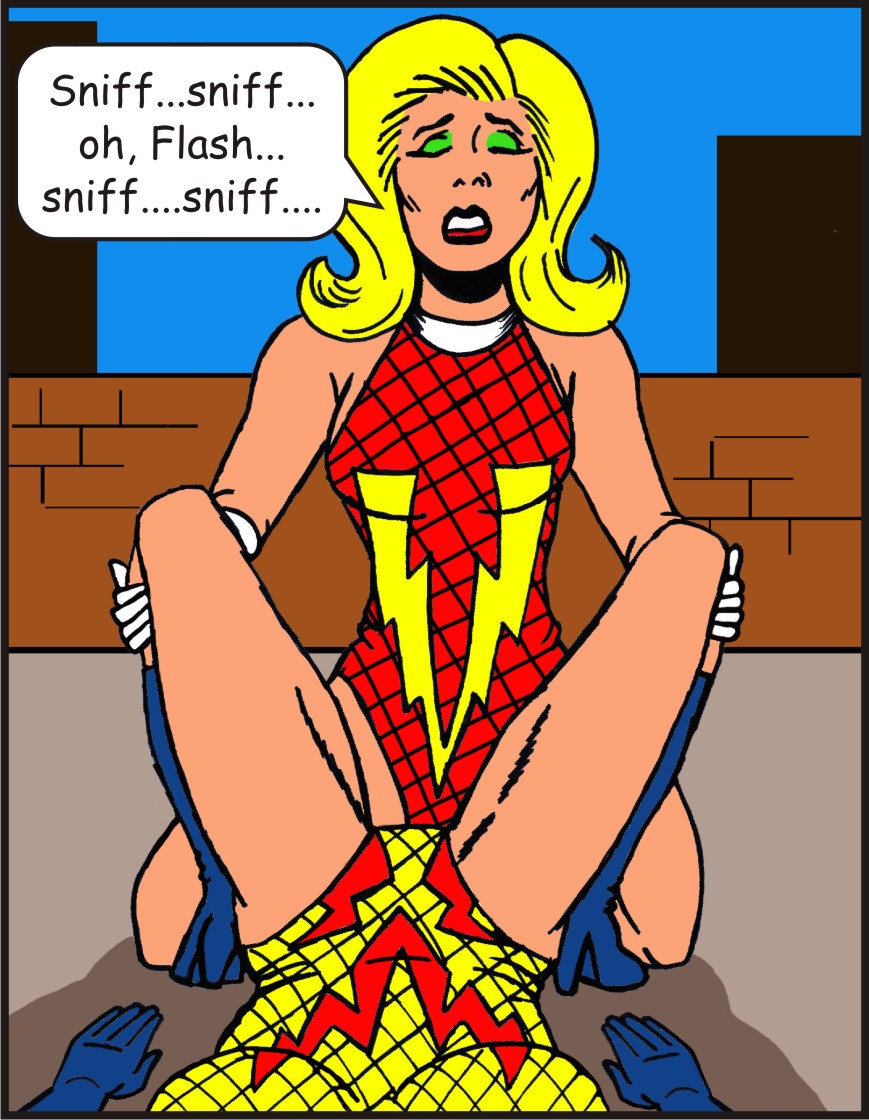
It's the 1960s and lesbian superhero Flick Faster meets her nemesis


Flash Fingers in action

The Flick Faster comic ran for 20 issues and had some of the most forward-thinking plots ever seen in comics. For instance, Flick’s nemesis was actually an evil clone of herself, although the process of cloning at the time was referred to as ‘chemical copying’. 

In this storyline, an evil female scientist, Dr. Honey Pott, devised an insidious plan called Operation Snatch & Grab which allowed her to acquire some strands of Flick’s hair. 

Placing these hairs in her ‘chromo-accelerator’, Pott grew an identical copy of Flick and fitted laser-firing technology in its fingertips. Calling her creation Flash Fingers, Pott programmed one simple mission into Flash’s blank mind - “ensure Flick Faster ends up in a box!” 

Dying her hair black and donning an inverted version of Flick’s costume, Flash went on to plague the heroine right up until Flick’s final issue. 

Flick grieves for her dead clone
That tearjerking story saw Flash finally get Flick right where she wants her but, just as she is about to kill her, Flash’s mental programming is overcome by the innate goodness in the genes she shares with Flick. Horrified at the evil woman she had become, Flash turns her fingers on herself. Flick cradles her deceased doppelganger and, in a fitting eulogy, states: 

“All this time I guess I was deep inside her. It’s a tragedy that her brief life should be brought to a climax by her own fingers. At least ... at least she's smiling. Rest in peace my sister!” 

Both Flash and Flick are referenced in Professor Iain R. Lattimer’s 2007 science textbook discussing the real possibilities of cloning a woman by the end of the century. Lattimer’s theories were radical and bold and his book became an international best seller, although this was mainly due to people thinking the title - Women Sharing the Same Cell - referred to girl-on-girl action in prison.


Flick Faster & the Mistress of the Mob

This recovered page from one of only 20 issues of the eponymous Flick Faster comic has Flick doing what she does best - fingering a female felon 

The 1960s. Gay superhero Bash Helmet grows big on the small screen

All of the success that Reggie was having with Flick made Godfrey Pryce determined to get more exposure for his beloved Helmet. And so, before the end of the decade, Bash was to be realised in yet another medium - television!

Searching for a new Bash, Pryce tirelessly held auditions for up and coming actors day and night in the back of his limousine. The part eventually went to Dale Montgomery, who ironically was not an actor but had only turned up to wash the car.

Montgomery recalls the day in his autobiography, Filling the Helmet:

“I was aware of a very tall, smartly dressed gentleman standing behind me, staring as I lathered up my sponge.

He smelt heavily of cigarettes and I could see butts scattered around him. I had just begun to wash the car windscreen when he approached me and gently took hold of my squeegee.

He told me who he was and that he had a big part for me if I wanted it. I explained that I wasn’t a professional actor but he replied that he wanted a fresh newcomer.

He instructed me to carry on washing the car but, as I did, to try and feel Bash Helmet enter my body and fill me up from inside.

The technique really worked - by the time I was waxing his exhaust pipe, I could feel myself slipping into another person.”

On July 31st 1969, Bash Helmet burst into living rooms in glorious colour. The TV show told a slightly different origin from the comics (mainly due to budget constrictions) as Justin Nicely discovers the mystical helmet in the back of an old closet bequeathed to him by his uncle, Jack.

With it is a cryptic note that simply says, 

“Use the helmet wisely for it shall take you up many dark paths! ”

Dale Montgomery as Justin, cradling his helmet as he ponders
the meaning of the note left by Jack Nicely

Click here to go on a journey through the history of Bash Helmet, the openly gay comic book superhero who debuted in 1941. 

Here we get a brief glimpse of his origin, his foes and his faithful sidekicks - all set to a revamped version of the theme tune to his 60s TV show.

Swinging in the Sixties: Television stardom takes our gay superhero Bash Helmet up many dark paths

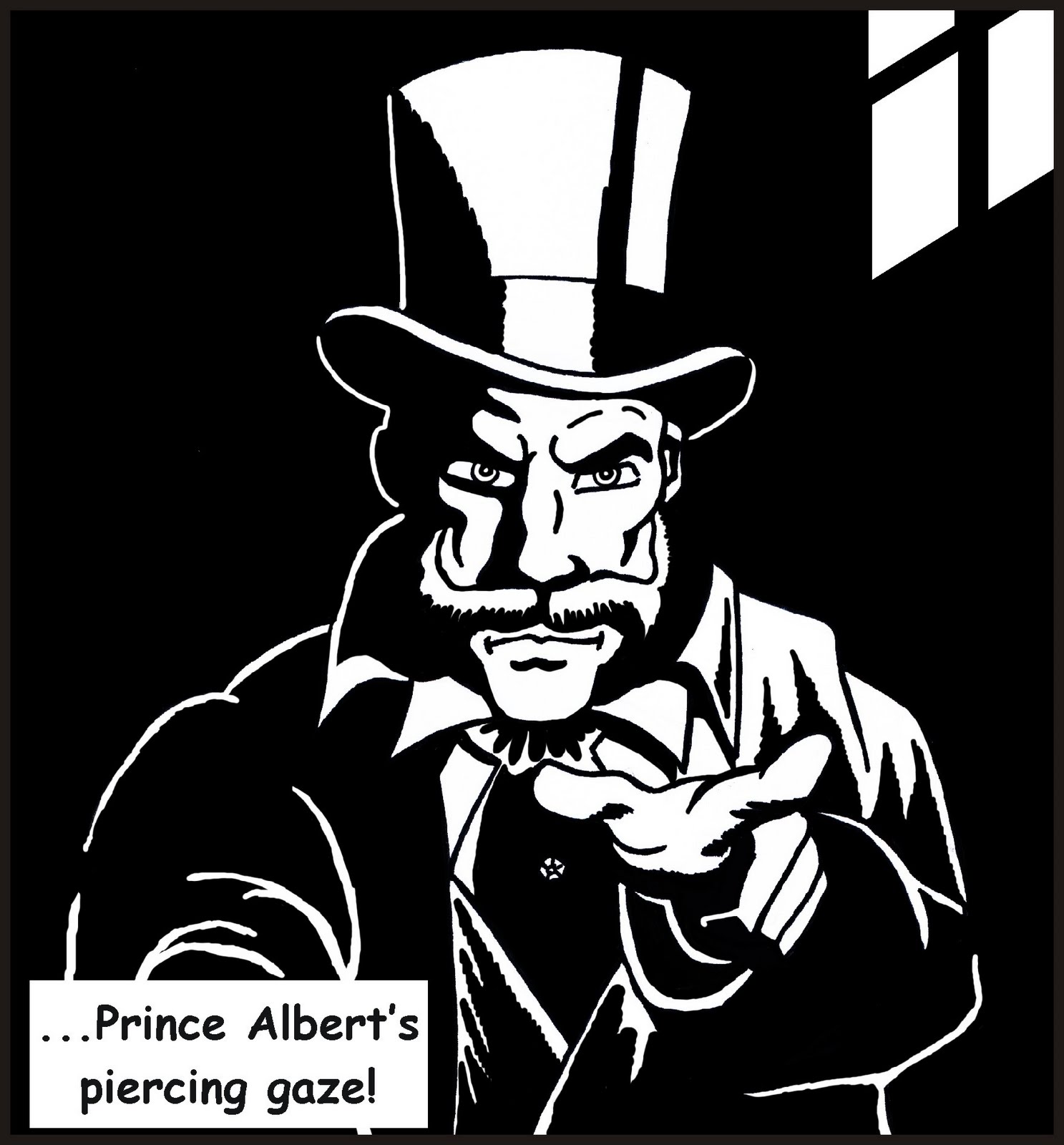
The only known panel of Prince Albert.
It isn't clear whether he always appeared in black and white.
Bash was taken up many dark paths as he came upon a variety of colourful and quirky villains during the twenty episode television run, including the sewer dwelling Manhole; the mediaeval knight Sir Gaggalad; the half-man/half-pig Stinky Pinky; the hot-headed and hot-bodied Flamer; the royal rogue Prince Albert; the serpent-loving Snake Handler; and the plant-controlling Lady Garden.

The plant-controlling Lady Garden
One particularly memorable episode sees Bash very nearly get married!

In “I Now Pronounce You Man & Strife!” the hero is placed under a trance with a kiss from the evil Lipnotist.

The villainess convinces him that they are due to get married and plans to have her henchmen rob the city while she keeps Bash busy at the church.

Fortunately Bash comes to his senses just as he is about to slip his ring onto her finger.

An uncensored recreation by the original artist shows how
Lipnotist's powers were compromised by the TV watershed

Bash Helmet in the 1970s. TV revives the Third Reich Dyke and Bash Helmet The Musical premieres

Bash Helmet's 1960s television series was a ratings smash and the network commissioned a further 30 episodes that ran from 1970 to 1971. 
The fans' favourite Third Reich Dyke,
Diva Braun, reappeared in the 1970s

This second season revived two adversaries from Bash’s past - Diva Braun (who, contrary to her comic book past, was not killed by Hitler but placed in suspended animation at the end of World War II and freed decades later to attack a present day America) and the Size Queen (now played by Hungarian drag artist, Agota Czoras). 

A fan-favourite episode was 'Bareback to the Future' in which Bash is sent forward in time to a war-ravaged, apocalyptic America and meets himself as an old man. The actor portraying the aged hero was none other than Rusty Clappe, the original Bash Helmet from the1950s movies! 

So far, everything Godfrey Pryce had produced had been very successful but the 1970s was to see Bona Ventures’ first commercial failure! 

Pryce continually wanted to push the boundaries with Bash and decided that the time was right for an ambitious Broadway musical! In 1972 while at a party in San Francisco, he saw a pair of young men playing together on a piano. 

Wes Humble frets while Bennie Langston
tickles his ivories
These musicians were Bennie Langston and Wes Humble and their party trick was to get people to shout out made-up song titles to which they would quickly compose tunes and improvise lyrics on the spot! 

Pryce needed composers to write a score for his musical and he realised that these men could knock one out at an impressive speed. 


He immediately propositioned them and, less than a year later, on 30th January 1973, Bash Helmet The Musical premiered at the Ambassador Theatre.